Overview
For engineers, procurement specialists, and plant managers, understanding the key structural and functional differences between these two valve styles is critical. This article will present a detailed comparison between the two valve styles butterfly valve and ball valves, including their design, the principles of material science, their respective ratings, their flow characteristics, their maintenance requirements, and the industries in which they perform best.
Key Takeaways
- Butterfly valves use a rotating disc mechanism and are ideal for large-diameter, low-to-medium pressure applications — offering a compact, lightweight, and cost-effective solution.
- Ball valves employ a spherical closure element that delivers a tight, reliable shutoff, making them the preferred choice for high-pressure and high-temperature systems.
- Material selection, pressure rating, flow requirements, and installation space all play critical roles in choosing the right valve type for your application.
- Butterfly valves excel in water treatment, HVAC, and large pipeline infrastructure; ball valves dominate in oil & gas, chemical processing, and steam systems.
- Neither valve is universally superior — the optimal choice depends on the specific process conditions, industry standards, and lifecycle cost considerations.
Introduction
In industrial flow control, selecting the right valve is not merely a procurement decision — it is an engineering imperative that directly affects system safety, operational efficiency, and total cost of ownership. Among the most frequently compared valve types in industrial applications are the butterfly valve and the ball valve. Engineering teams find that the internal mechanisms, material demands, pressure capabilities, and ideal application environments of both quarter-turn devices designed to regulate or isolate fluid flow differ substantially.
For engineers, procurement specialists, and plant managers, understanding the key structural and functional differences between these two valve styles is critical. This article will present a detailed comparison between the two valve styles, including their design, the principles of material science, their respective ratings, their flow characteristics, their maintenance requirements, and the industries in which they perform best.
Design & Mechanism
Design Principles and Mechanical Operation
The first and perhaps most significant difference between a butterfly valve and a ball valve is their respective internal mechanism for closing off the flow. This difference has a significant effect on almost every aspect of the respective valve styles.
Butterfly Valve: Disc-Based Rotation
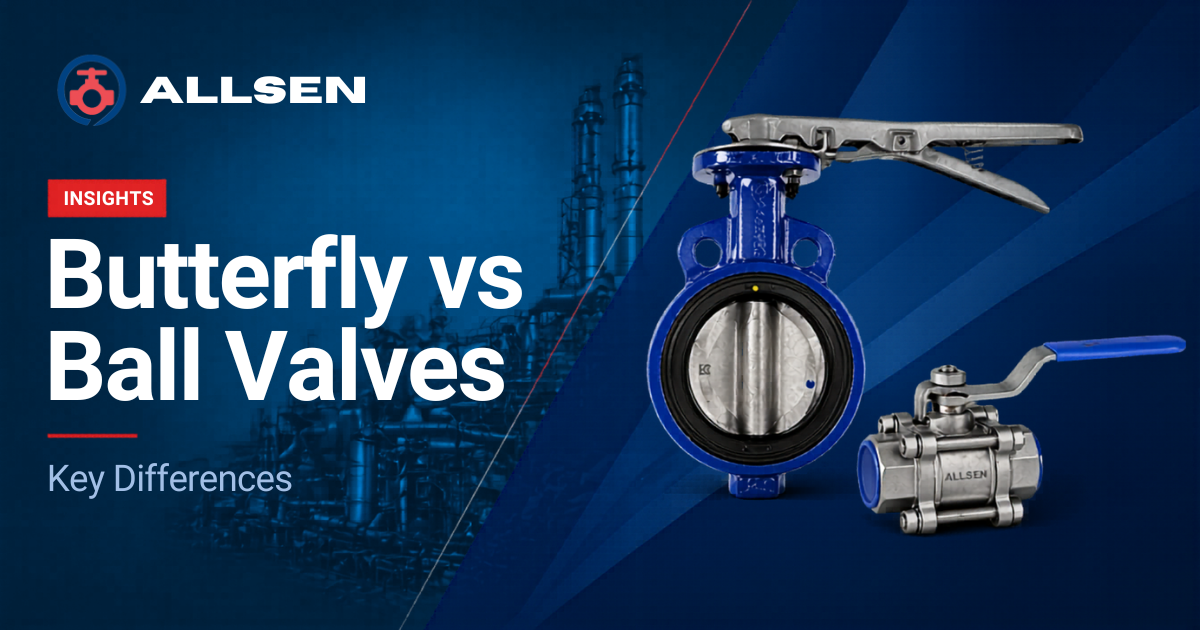
The mechanism for the butterfly valve is the rotation of a disc that is mounted on a rotating axis located in the center of the pipeline. By rotating the disc by 90 degrees, the disc goes from a fully open position, where the disc is parallel to the flow, to a fully closed position, where the disc is at a 90-degree angle to the flow. The simplicity of the mechanism is a significant advantage for the butterfly valve, which is a relatively light-weight valve requiring a minimal face-to-face installation area. This is a critical advantage for the butterfly valve, especially for larger diameter valves, where the weight and footprint can be a significant contributor to the overall installed cost.
The butterfly valves come in three different styles: the concentric butterfly valve, the double-offset butterfly valve, and the triple-offset butterfly valve. In the triple-offset butterfly valve, the disc is designed in a fashion where the disc only touches the seat at the end of the rotation. The result is a butterfly valve that is capable of achieving ANSI Class VI shutoff with a laminated metal seat.
Ball Valve: Spherical Closure Precision
The ball valve operates on a principle where a hollow, perforated sphere (ball) turns inside a hollow cylinder. When the sphere turns 90°, it shuts off completely. When it turns to align with the pipeline, it allows for unimpeded flow. The ball closes tightly, almost “bubble tight,” as defined in API 6D and ANSI/FCI 70-2 standards.
Ball valves are either full-bore or reduced-bore. Full-bore ball valves are essential for oil and gas pipeline systems. They allow for pipeline cleaning with a pig. The tight seal between the ball and seats, made of polymeric or metallic material, ensures a tight seal at a wide range of high pressures.
“The choice between a quarter-turn disc and a quarter-turn sphere is, in engineering terms, a choice between compactness and closure integrity — both are quarter-turn technologies, but their performance envelopes are distinct.”
Materials & Ratings
Materials, Pressure, and Temperature Ratings
Material science plays a crucial role in choosing a particular type of valve for a particular industrial process. Both butterfly as well as ball valves are made from a wide variety of materials. However, their geometric configurations make them more or less suitable for a particular range of pressure or temperature.
Butterfly Valve Materials
The material of construction for a butterfly valve body usually includes cast ductile iron, carbon steel, stainless steel (CF8M, CF3M), and duplex stainless steel for aggressive service. The material for the disc may include ductile iron with a coating, stainless steel, or other special alloys such as Hastelloy or titanium for aggressive service. The seat material may be considered to have the greatest influence on valve performance. EPDM, NBR, PTFE, and VITON are widely used for resilient-seated designs. For metal-seated designs, higher temperatures up to 600°C are achievable.
The standard concentric butterfly valves are rated for ASME Class 150/300. However, double offset or triple offset butterfly valves have higher pressure ratings of Class 600, 900, or 1500.
Ball Valve Materials
Manufacturers make the ball valves from carbon steel (A216 WCB), stainless steel (A351 CF8M), chrome moly steel (A217 WC6, WC9), or corrosion-resistant alloys for aggressive chemical service.The seat material for ball valves includes PTFE for normal service. However, for higher temperatures, manufacturers use PEEK or metal-to-metal seats.Engineers rate ball valves for ASME Class 150 to 2500.Users employ ball valves for ultra-high-pressure applications in refineries, petrochemical plants, or LNG service where they encounter pressures as high as 5,000 psi.
| Parameter | Butterfly Valve | Ball Valve |
|---|---|---|
| Pressure Class | Class 150–1500 (triple-offset) | Class 150–2500 |
| Temp. Range | −29°C to 600°C+ | −196°C to 650°C+ |
| Body Materials | DI, CS, SS, Duplex | CS, SS, CrMo, Alloys |
| Seat Materials | EPDM, PTFE, Metal | PTFE, PEEK, Metal |
| Shutoff Class | Class IV–VI | Class V–VI (bubble-tight) |
| Size Range | DN50–DN3000+ | DN6–DN900 |
Flow & Application
Flow Characteristics and Industry Applications
It is important for system engineers and designers of processes to understand how each of these valves interacts with the fluid stream. The difference in flow profile, pressure drop characteristics, and throttling/isolation capability of each of these valves varies significantly.
Flow Behaviour
The inherently turbulent nature of the flow characteristic of a butterfly valve, particularly in a concentric type where the valve disc is in line in an open position, makes it less suitable for throttling services. Although high-performance types of butterfly valves offer improved flow coefficients, their inherently equal percentage or modified equal percentage characteristics make them suitable for throttling services in HVAC and water distribution applications. Ball valves, on the other hand, offer a near-linear or quick opening characteristics depending on the design. There is negligible pressure drop in a ball valve in a full-bore open position. This makes ball valves suitable for low-pressure-drop services.
Key Industry Applications
- Water & Wastewater Treatment: Operators use butterfly valves in large pipeline diameters in water and wastewater treatment plants (DN600-DN3000). The light weight of a butterfly valve and its seats offer excellent sealing performance in water and wastewater services at a fraction of the cost of a ball valve.
- Oil & Gas Upstream/Midstream: Technicians use ball valves in wellheads, gathering lines, and transmission lines. Ball valves comply with API 6D standards.
- Chemical & Petrochemical Processing: Engineers use both types of valves in chemical plants.Technicians use ball valves for aggressive solvents and high pressure reactor feeds, while they use butterfly valves for bulk storage and loading/unloading lines, constructed from corrosion-resistant alloys.
- Power Generation: Designers use high-performance triple-offset butterfly valves extensively in thermal and nuclear power plants for steam isolation and turbine bypass.Technicians use ball valves for fuel gas, feedwater, and condensate systems.
- HVAC & Building Services: Installers use concentric butterfly valves extensively in commercial HVAC systems. They are cost-effective, light weight, and well-suited for moderate pressure and temperature applications, such as heating/cooling water systems.
- LNG & Cryogenic Service: Engineers use cryogenic ball valves, with long bonnets extending beyond the top of the valve to protect the valve packing from extreme cold temperatures down to -196°C, in LNG storage and transfer systems.
Maintenance & Economics
Maintenance, Lifecycle Cost, and Installation Considerations
Operational reliability, or cost of ownership, is as important as initial cost when selecting a valve. The maintenance considerations for, and installation requirements of, both ball valves and butterfly valves are discussed below.
Maintenance Profile
Butterfly valves are generally easier to maintain. Fewer parts, i.e., body, disc, shaft, seat, and packing, mean less chance for failure. Resilient-seated butterfly valves permit in-line seat replacement without removing pipes. Frequent throttling applications, however, may require periodic inspections for seat wear on concentric designs.We have found that triple-offset metal-seated butterfly valves have a service life in excess of 10,000 operating cycles with no discernible seat wear.
Ball valves, particularly in high-pressure or high-temperature applications, need to address seat wear from abrasive products or from repeated operation. The trunnion-mounted ball valves, where the trunnions retain the ball on top and bottom instead of seats, minimize operating torques and seat loading, thereby increasing service life in tough applications. Fire-safe designs with secondary metal seats ensure safe operation even in the case of failure of the elastomeric seat, a key safety compliance criterion for API 607 and BS EN ISO 10497.
Installation and Space Considerations
The key advantage of butterfly valves over ball valves comes in terms of installation space. Butterfly valves have a wafer or lug design that fits snugly between the pipeline flanges with a small face-to-face dimension. Ball valves, particularly for larger sizes or higher pressure rating, require significantly more axial and lateral space, thereby increasing installation costs.
Economics
With regard to the costs, for larger diameter valves above DN300, the butterfly valve is generally 30-60% less expensive than the equivalent ball valve. However, for smaller bore, high-pressure, or critical isolation duty, the reliability advantage and maintenance cost savings provided by the ball valve generally outweigh the extra capital expense, yielding a reduced total installed cost for the system over a 20-30 year life cycle.
Conclusion
The question of choosing between a butterfly valve and a ball valve is not a simple matter of choosing between a good solution and a bad solution. Rather, engineers conduct a complex evaluation for the selection that depends on the requirements of the application, the industry in which the application is deployed, the installation requirements, and the lifecycle costs. Butterfly valves represent the best value for a wide range of large diameter, moderate pressure fluid handling requirements, while the ball valve is the best solution for critical shutoff, high-pressure, and isolation duty.
As the state-of-the-art in valve technology continues to evolve, with the high-performance butterfly valve now encroaching on the traditional ball valve market with its triple-offset design, and the trunnion ball valve now growing to larger diameters than ever before, the lines between the two products continue to blur. The best determinant for making the selection between the two products is a detailed evaluation of the parameters of the application against the ability of the two products to meet the requirements. In the end, the selection of a valve is a critical engineering evaluation that is a key determinant of the profitability of the operation.
FAQs
Standard concentric butterfly valves are limited to ASME Class 150/300 pressure ratings. However, high-performance double-offset and triple-offset butterfly valves can achieve Class 600, 900, and 1500 ratings with metal seats, making them viable for many high-pressure services previously reserved for ball valves. Always verify the pressure-temperature rating against your specific process conditions and applicable design codes.
Ball valves are generally not recommended for sustained throttling due to the potential for seat erosion and cavitation when partially open. Butterfly valves — particularly high-performance designs — offer better inherent flow characteristics for modulating service and are widely used in flow control applications. For precise throttling, consider pairing either valve type with an appropriate actuator and positioner.
In small-to-medium bore sizes (DN15–DN200), the cost difference can be modest. The cost gap widens significantly for large-diameter valves (DN300+), where butterfly valves offer substantial savings in both the valve body and installation. However, for high-pressure, high-temperature, or critical isolation services, the engineering performance of ball valves often delivers a lower total cost of ownership despite the higher purchase price.
Bubble-tight shutoff refers to ANSI/FCI 70-2 Class VI leakage — the most stringent seat leakage classification, permitting essentially zero detectable leakage. Soft-seated ball valves routinely achieve Class VI shutoff. High-performance triple-offset butterfly valves with metal seats can also achieve Class VI in appropriate designs. The appropriate shutoff class for your application should be specified in accordance with applicable piping standards such as ASME B31.3 or API 6D.
Explore Our Valve Solutions
Whether your application demands the compactness of a high-performance butterfly valve or the shutoff integrity of a precision ball valve, our engineering team is ready to help you specify the right solution for your process conditions.
Contact Our Engineers →