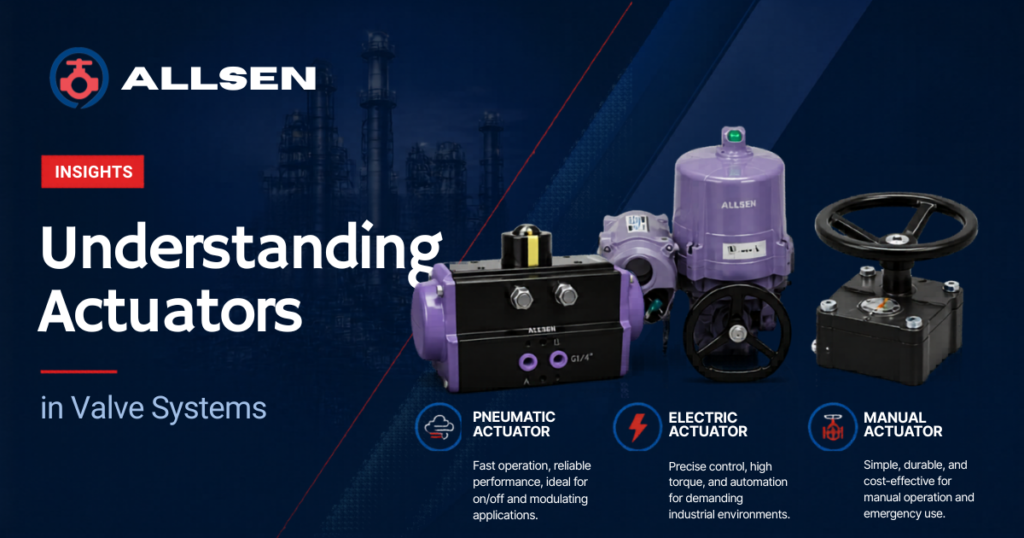
Understanding Actuators in Valve Systems
A guide to actuators in valve systems, covering manual, electric, and pneumatic…
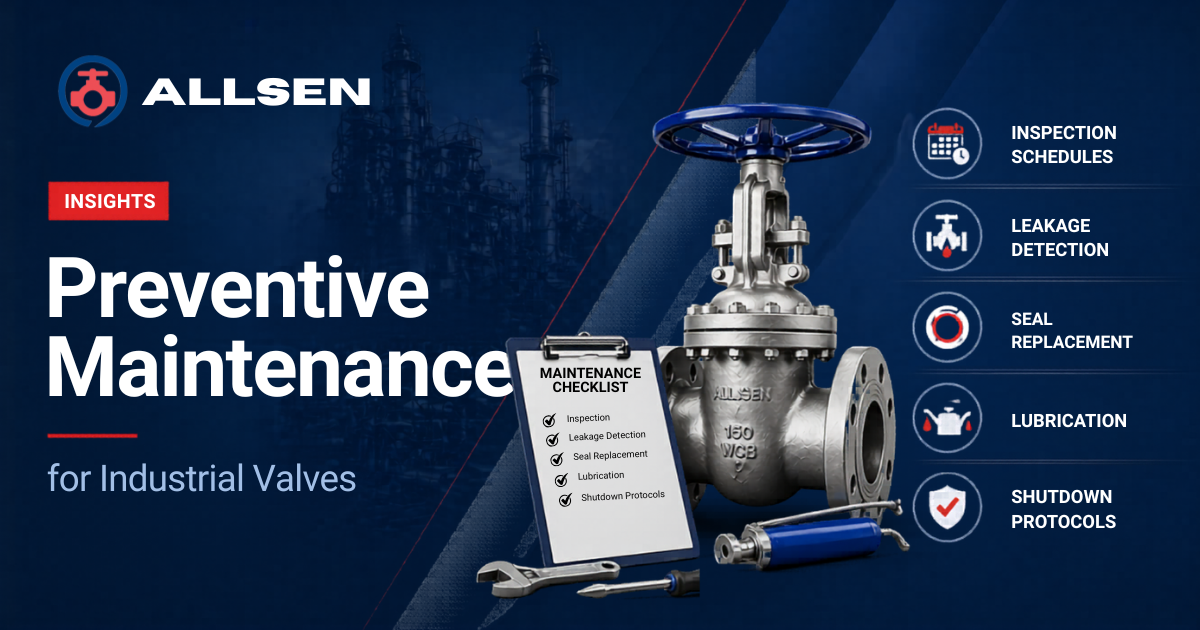
A practical, plant-reliability-focused guide to inspection schedules, leakage detection, seal replacement, lubrication, and shutdown protocols that keep your valve assets performing at full capacity.
Valves are the most common and crucial mechanical parts in any industrial plant, be it a chemical processing unit, power plant, refinery, or water treatment facility. They control pressure, isolate equipment, regulate flow, and serve as the last line of defense between a hazardous event and regular operation in safety-critical applications. Nevertheless, valves are among the most neglected assets in many maintenance programs, despite being essential to plant dependability.
Plant engineers are well aware of the consequences of neglecting valve maintenance: fugitive emissions that draw regulatory attention, unscheduled process shutdowns that cost tens of thousands of dollars per hour, deteriorated flow control that jeopardizes product quality, and, in the worst situations, safety incidents that put people and infrastructure in danger. The engineering discipline that breaks this chain before it begins is called preventive maintenance.
The five key disciplines that drive plant reliability—structured inspection schedules, proactive leak detection, timely seal replacement, proper lubrication practices, and efficient shutdown inspection protocols—are the focus of this article’s thorough, practically oriented guide to preventive valve maintenance.
Inspection Schedules
A structured inspection schedule is not simply a maintenance calendar — it is a systematic risk management framework that assigns the right level of attention to each valve based on its criticality, service conditions, and historical performance. Without a defined schedule, maintenance becomes reactive by default, and reactive maintenance consistently delivers worse reliability outcomes at higher cost than its preventive counterpart.
Effective valve inspection programs are organized across multiple time horizons, each serving a distinct purpose in the reliability hierarchy. Routine operational checks — conducted daily or weekly by plant operators — focus on observable indicators: external corrosion, visible leakage at glands or body joints, abnormal noise or vibration, actuator position feedback anomalies, and signs of mechanical damage. These front-line checks are the earliest warning layer in the maintenance program and should be formally recorded, not simply observed.
Monthly and quarterly inspections escalate the rigor: verifying actuator operation and response times, checking manual override functionality, confirming lubricant levels in gearboxes, and conducting baseline fugitive emissions screening using portable analyzers. For control valves, this interval is appropriate for reviewing positioner calibration and comparing actual versus commanded valve position to detect developing seat or trim wear.
A formal criticality assessment — typically a consequence-of-failure analysis that weighs the impact of valve failure on safety, production continuity, environmental compliance, and asset integrity — should inform the inspection frequency assigned to each valve. Safety instrumented system (SIS) valves and emergency shutdown devices (ESDVs) carry their own inspection and proof-test frequency requirements, mandated by IEC 61511 and defined in the safety instrumented function’s safety requirements specification.
| Inspection Activity | Frequency | Applicable Valve Types |
|---|---|---|
| Visual external check, leakage scan | Monthly | All process valves |
| Actuator function & feedback verification | Quarterly | Automated & control valves |
| Fugitive emissions (EPA Method 21 / TA Luft) | Quarterly | VOC / toxic fluid service |
| Packing & gland adjustment / replacement | Annual | Gate, globe, control valves |
| Full internal overhaul & seat inspection | Shutdown | Critical isolation & control |
| ESD / SIS proof testing | Per SRS | Safety instrumented valves |
Maintaining a digital valve register — recording inspection dates, findings, work orders, and condition trends — transforms a collection of individual inspection events into a longitudinal asset health dataset. Over time, this data reveals patterns: which service environments accelerate packing wear, which valve types require more frequent seat attention, and where condition-based maintenance intervals can safely replace fixed-interval schedules to reduce unnecessary intervention costs.
Leakage Detection
Valve leakage — whether internal seat leakage degrading process isolation, or external fugitive emissions escaping via stem packing and body joints — is both a reliability indicator and a regulatory compliance obligation. Early, systematic leakage detection is one of the highest-return activities in any preventive maintenance program, enabling intervention before a minor seep becomes a major release.
External leakage at the stem packing is the most common and most regulated form of valve leakage in process plants handling volatile organic compounds (VOCs), hydrogen sulfide, or other hazardous substances. Regulations including the U.S. EPA’s Equipment Leaks standard (40 CFR Part 60/63), the European Industrial Emissions Directive (IED), and the German TA Luft standard define permissible leakage thresholds and monitoring frequencies. Facilities must implement formal Leak Detection and Repair (LDAR) programs, using portable hydrocarbon analyzers calibrated to EPA Method 21 to screen valves at specified intervals and document findings.
Optical Gas Imaging (OGI) using infrared cameras has become a widely adopted complement to contact-measurement methods for fugitive emission surveys. OGI cameras visualize hydrocarbon vapor plumes invisible to the naked eye, enabling rapid survey of large valve populations and prioritization of repairs. While OGI cannot provide the quantitative concentration measurement required for regulatory reporting under Method 21, it is an efficient screening tool for directing contact measurements to the highest-emitting components.
Internal seat leakage — where fluid bypasses the closed valve through a worn or damaged seat — is harder to detect in service but equally damaging to process control and operational efficiency. In isolation valves, seat leakage allows pressures to equalize across the closed valve, preventing safe equipment isolation for maintenance. Detection methods include downstream pressure monitoring, acoustic emission testing (AET) using sensors clamped to valve bodies or adjacent pipework, and ultrasonic leak detection equipment that identifies the high-frequency signature of fluid passing through a restricted seat gap.
Maintenance Tip: In LDAR-regulated services, supplement Method 21 contact measurements with an OGI camera survey at every quarterly inspection round. OGI surveys covering hundreds of components per hour will identify the small proportion of high-emitters that account for the majority of total fugitive emission mass, allowing targeted repair resources to deliver maximum compliance and environmental benefit.
Seal Replacement
Valve seals — encompassing stem packing, body gaskets, seat seals, and bonnet seals — are consumable components by design. They engineer the design to maintain sealing integrity across defined operating cycles and service conditions, but it will inevitably degrade. The question for a reliability-focused maintenance program is not whether seals will require replacement, but whether that replacement happens on a planned, controlled schedule or in response to an uncontrolled leak event.
Stem packing is the most frequently replaced seal in valve maintenance practice. PTFE-based packing sets, graphite packing rings, and braided packing materials each have distinct performance characteristics and replacement triggers. PTFE packing in moderate-temperature services typically tolerates 50,000 to 150,000 operating cycles before significant leakage develops; graphite packing in high-temperature steam or hydrocarbon service may require re-torquing or replacement on an annual cycle in high-duty applications. Key replacement indicators include visible leakage past the gland follower, inability to achieve a seal by gland adjustment without exceeding the manufacturer’s maximum gland follower torque, and LDAR readings at or approaching the regulatory action level.
For emission-sensitive services subject to ISO 15848-1, TA Luft, or API 624 (fugitive emission testing for rising stem valves), the selection of a certified, low-emission packing system is mandatory — and replacement must restore the valve to its certified configuration. Using uncertified packing as a substitute in these valves constitutes a compliance breach, irrespective of the achieved sealing performance.
Seat seals in soft-seated ball and butterfly valves — PTFE, EPDM, PEEK, or elastomeric seat inserts — require replacement when leakage testing against ANSI/FCI 70-2 reveals degradation beyond the specified acceptance class. In high-cycle automated services, maintaining a programmatic seat seal replacement interval based on cycle count (available from valve positioner or actuator data) is more reliable than calendar-based scheduling. For metal-seated valves, seat lapping or grinding during shutdown inspections restores the sealing interface without full seat replacement.
Lubrication Practices
Although lubrication is one of the simplest and most profitable tasks in valve preventive maintenance, people often overlook it, apply it incorrectly, or use lubricants that are incompatible with the service fluid or operating conditions. Proper lubrication reduces stem and packing friction, protects thread engagement surfaces, extends gearbox and actuator service life, and prevents the fretting and galling that makes valves difficult or impossible to operate after extended static periods.
The lubrication requirements of industrial valves vary substantially by valve type and component.
Stem threads on rising-stem gate and globe valves require a lubricant that maintains film strength under the compressive loads of valve opening and closing, resists washout or degradation from process fluid exposure, and remains stable across the operating temperature range. Molybdenum disulfide (MoS₂)-based greases, nickel-based anti-seize compounds, and PTFE-based lubricants widely serve this application, with users selecting them based on temperature capability and compatibility with the stem and yoke materials.
Plug valve lubricant injection — a distinctive feature of lubricated plug valve designs — maintains the thin lubricant film between the tapered plug and body that provides both the primary seal and the lubrication necessary for operation. Technicians must perform lubricant injection at defined intervals using the correct grade of valve lubricant (typically a grease formulated for chemical compatibility with the process fluid), recording the injection pressure and volume to detect abnormal consumption that may indicate seat wear or body erosion.
Actuator and gearbox lubrication is an equally critical but often overlooked element. Pneumatic actuators with internal spring packs may require periodic re-lubrication of spring and bearing surfaces; electric actuator gearboxes require oil or grease changes at manufacturer-specified intervals, with lubricant condition monitored for moisture ingress or contamination. Neglected gearbox lubrication is a leading cause of increased breakaway torque and actuator motor failures in automated valve systems.
Shutdown Inspection
The planned plant turnaround or shutdown is the single most valuable opportunity in the valve maintenance calendar. It is the only window in which the full internal condition of in-service valves can be assessed, dimensional measurements taken against original specifications, worn or damaged components replaced, and performance verified before the plant returns to service. Given the typically high cost of turnaround labor and the limited time available, maximizing the technical value of every valve inspection during a shutdown is a critical planning and execution discipline.
Effective shutdown valve inspection begins months before the outage, identifying which valves will undergo internal inspection, receive in-line servicing, or require only external checks. Criticality ranking, in-service condition monitoring data, prior inspection history, and changes in process conditions should drive this scope. Attempting to inspect every valve in a plant during a single turnaround is neither practical nor necessary; a risk-informed scope delivers superior reliability outcomes within realistic resource constraints.
During the inspection itself, a documented inspection protocol — aligned with applicable standards such as API 598 (valve testing and inspection) and API 6D (pipeline valves) — should govern the sequence and acceptance criteria for each activity. Internal visual inspection addresses seat condition, disc or ball surface integrity, body wall condition, stem surface and thread condition, and evidence of corrosion, erosion, or cavitation damage. Dimensional measurements — seat bore diameter, stem diameter and roundness, body wall thickness via UT — quantify wear against original specifications and inform remaining service life assessments.
All findings should be graded against a defined disposition matrix: return to service as-found (for valves meeting acceptance criteria), repair or refurbish (seat lapping, packing replacement, component exchange), or replace (for valves where repair is uneconomical or where end-of-life condition is reached). A disciplined disposition process prevents two equally costly errors: returning a compromised valve to service prematurely and replacing serviceable valves unnecessarily.
Maintenance Tip: Assign each valve returned from shutdown inspection a revised next inspection interval based on the as-found condition rather than defaulting to a fixed calendar-based cycle. A valve found in near-new condition can safely carry a longer interval; one showing early-stage deterioration warrants a shortened cycle. Condition-informed intervals reduce total maintenance burden while improving reliability outcomes.
ESD valves require a structured maintenance program linked to their Safety Instrumented Function (SIF). Follow standards such as IEC 61511. Define proof test intervals and methods in the Safety Requirements Specification (SRS). Ensure they match the required Safety Integrity Level (SIL). Use partial stroke testing (PST) between full proof tests. This checks valve operation without interrupting the process. Maintain clear records of all tests and inspections. These support compliance and demonstrate functional safety performance.
Our field service and workshop teams provide the full spectrum of valve maintenance support — from scheduled packing replacements and fugitive emission surveys to comprehensive shutdown overhauls, seat lapping, actuator servicing, and post-repair performance testing. Whether you need a single critical valve restored or a plant-wide maintenance program structured, we bring the engineering expertise and OEM-quality parts to keep your valve assets performing at full reliability.