Overview
A practical engineering comparison covering isolation versus control, pressure drop, operating conditions, and the key advantages and limitations of Gate Valve and Globe Valve.
Key Takeaways
- Gate valves are primarily intended for isolation duty, providing minimal pressure drop and unrestricted flow when open.
- Globe valves are excellent at flow control and throttling, providing precise regulation while introducing a higher inherent pressure drop due to their S-shaped flow path.
- Neither valve is appropriate for the other’s primary function. Throttling with a gate valve causes rapid seat erosion, whereas using a globe valve with a low pressure drop is inefficient.
- Operating conditions, such as pressure, temperature, fluid type, and cycle frequency, are critical factors in deciding between the two.
- Understanding the mechanical differences between these two classic valve types is critical for effective piping system design and long-term plant reliability.
Gate valves and globe valves are among the oldest and most commonly used valve types in industrial piping systems. Both are linear motion valves. Both are used in a wide range of industries, including oil and gas and water treatment. However, they serve fundamentally different functions, and mistaking one for the other is a common and costly engineering error.
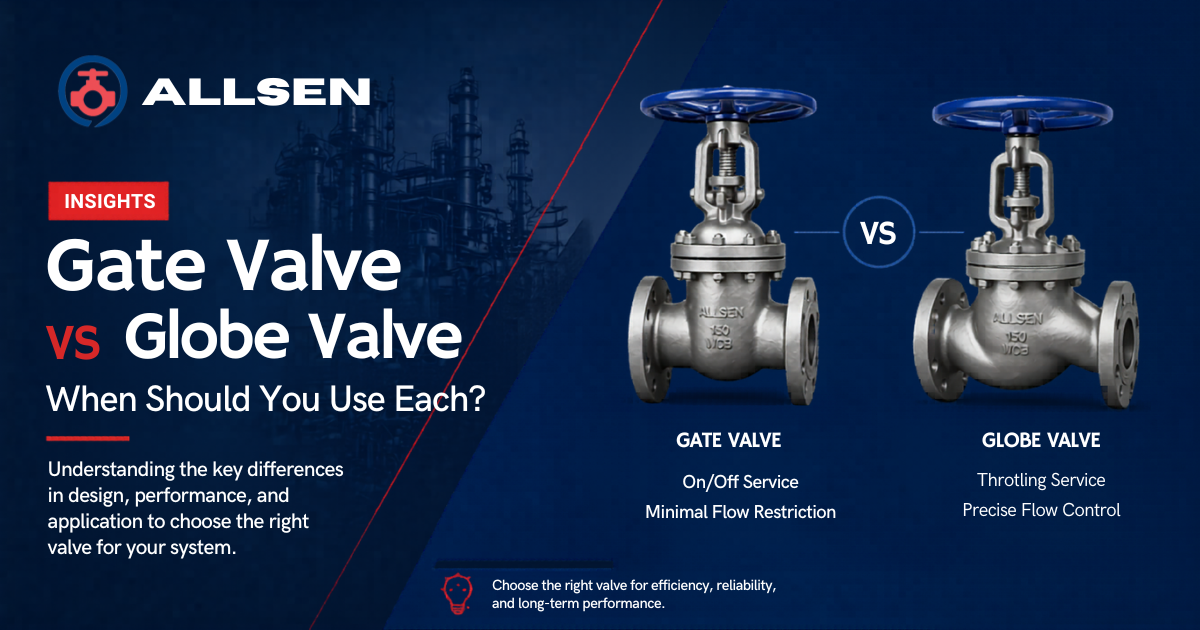
The gate valve is an isolation device. It is designed to either completely stop the flow or allow it to pass unhindered. In contrast, the globe valve functions as a control device. It is intended to regulate flow precisely across a variety of operating positions. This fundamental distinction underpins all other differences between them, from internal geometry and pressure drop characteristics to ideal operating conditions and maintenance requirements.
This article goes over both valve types in detail. It discusses isolation versus control functions, pressure drop behavior, operating conditions, and the practical benefits and drawbacks of each. The goal is to provide engineers and procurement teams with a clear, reliable foundation for making the right decision in their specific application.
Core Function
Isolation vs Flow Control: The Defining Difference
The most important distinction between a gate valve and a globe valve is their intended function. Understanding this distinction prevents misapplication — one of the leading causes of premature valve failure in industrial systems.
A Gate Valve features a flat or wedge-shaped gate that slides perpendicularly across the flow path. When fully opened, the gate retracts completely into the bonnet. This results in a clear, unobstructed bore through the valve body. As a result, flow passes with minimal resistance and virtually no turbulence. However, the gate valve is not designed to be used in intermediate positions. The gate is partially open, allowing high-velocity flow to pass across its face. This leads to vibration, chatter, and rapid erosion of the gate and seat surfaces. As a result, gate valves should only operate when fully open or closed.
A Globe Valve works by moving a disc or plug vertically against a stationary seat ring perpendicular to the flow path. This geometry produces a natural throttling effect. The stem position allows you to precisely adjust the gap between the disc and the seat. This makes the globe valve ideal for flow regulation, pressure reduction, and start/stop applications that require frequent cycling. As a result, globe valves are the preferred choice for control applications requiring the valve to spend time between fully open and fully closed positions.
Gate Valve
- Full isolation of process lines
- Infrequent on/off operation
- Low pressure-drop pipelines
- Large-diameter pipework
- Piggable pipeline systems
Globe Valve
- Throttling and flow regulation
- Frequent cycling service
- Precise flow or pressure control
- Steam and high-temperature fluids
- Small to medium bore pipework
In summary, the gate valve answers the question: is the line open or closed? The globe valve answers: how much flow should pass? Selecting the right valve begins with identifying which question your application requires.
Hydraulic Performance
Pressure Drop: Why Flow Path Geometry Matters
Pressure drop is one of the most significant performance differences between gate and globe valves. It has a direct impact on pumping energy costs, system efficiency, and the suitability of each valve type for a specific application.
A fully open gate valve provides a nearly straight-through flow path. The fluid moves through the valve body with little change in direction. This produces a very low pressure drop, which is typically characterized by a high flow coefficient (Cv). This feature is extremely useful in large-diameter pipelines carrying high-volume flow. Even minor reductions in pressure drop across multiple valves result in significant energy savings over the life of a pumping system.
In contrast, a globe valve forces the fluid to travel in an S-shaped path through the valve body. The flow enters through the bottom of the seat, changes direction through the disc opening, and then exits. Even when fully open, this tortuous path produces a significantly higher pressure drop than a gate valve of the same size. As a result, the globe valve is an unsuitable choice for applications where reducing pressure drop and energy loss is critical.
Engineering Note: When comparing equivalent nominal bore sizes, a globe valve in the fully open position can generate three to five times the pressure drop of a gate valve in the same line. In high-flow or energy-sensitive systems, this difference has a measurable impact on operating costs.
However, the globe valve’s higher pressure drop is not purely a limitation. In throttling service, that resistance is exactly what provides the control authority needed to regulate flow precisely. The same geometry that penalises a globe valve in an open pipeline makes it highly effective in a control loop.
Therefore, the selection decision should include a simple hydraulic question: does your system require minimum resistance, or does it require controllable resistance? The answer guides the choice clearly.
Application Engineering
Operating Conditions: Matching the Valve to the Service
Pressure, temperature, fluid characteristics, and cycle frequency all influence which valve type is the correct choice. Reviewing each operating condition in context helps eliminate misapplication before it reaches the field.
Pressure and Temperature
Gate valves are available for all ASME pressure classes, from Class 150 to Class 2500. They work reliably in high-pressure, high-temperature applications like steam, hot oil, and high-pressure gas pipelines. However, thermal cycling can have an impact on their sealing performance because the gate and body expand and contract at different rates. Flexible wedge and split wedge gate valve designs address this issue by accommodating thermal distortion while maintaining shutoff.
Globe valves are also available for a wide range of pressures and temperatures. They are, however, especially well suited to steam service, which includes saturated and superheated steam applications in power generation and process plants. Their disc-and-seat geometry ensures dependable, repeatable sealing even under thermal cycling conditions. This is why globe valves are still the preferred choice for steam trap bypass lines, boiler feedwater circuits, and pressure-reducing stations.
Fluid Characteristics and Cycle Frequency
For clean fluids in isolation service, both valve types perform reliably. However, for slurries, viscous fluids, or media with suspended solids, neither valve type is ideal without specific design modifications. Globe valves, with their narrow annular flow path, are more susceptible to solids deposition than gate valves. Gate valves in slurry service require knife gate designs with scraper seats to maintain reliable closure.
Cycle frequency is equally important. Globe valves are engineered for frequent operation — their disc and seat geometry is designed to withstand thousands of cycles with minimal wear when correctly specified. Gate valves, by contrast, are designed for infrequent operation. Frequent cycling accelerates seat wear and stem thread fatigue in gate valve designs, shortening service life considerably.
| Operating Factor | Gate Valve | Globe Valve |
|---|---|---|
| Pressure drop (fully open) | Very low | Moderate to high |
| Throttling suitability | Not recommended | Excellent |
| Cycle frequency | Low (infrequent) | High (frequent) |
| Steam service | Suitable | Preferred |
| Large bore pipelines | Preferred | Less common |
| Isolation shutoff quality | Excellent (full bore) | Good |
| Flow direction sensitivity | Bidirectional | Unidirectional (preferred) |
Engineering Assessment
Advantages and Limitations: An Honest Assessment
Every valve type involves a set of engineering trade-offs. Understanding the advantages and limitations of gate and globe valves honestly — rather than viewing either as universally superior — leads to better specification decisions and longer service life.
Gate Valve: Advantages and Limitations
The primary advantage of the gate valve is its low flow resistance. When fully open, it offers a full-bore, unobstructed passage that minimises energy loss and allows the passage of pigs for pipeline inspection and cleaning. It is also bidirectional, making it flexible in system design. Gate valves are well established across oil and gas, waterworks, and industrial process piping, with a broad range of materials, sizes, and pressure ratings available from manufacturers worldwide.
However, gate valves have notable limitations. They are slow to operate and multiple turns of the handwheel are required to open or close, which makes them poorly suited to rapid-response applications. They are susceptible to seat damage if used in throttling service. Additionally, large gate valves can be heavy and require significant actuator torque, especially after extended periods in the open position where the gate may adhere to guides.
Globe Valve: Advantages and Limitations
The globe valve’s main advantage is its controllability. It has excellent throttling characteristics, a consistent shutoff after repeated cycling, and simple maintenance. The seat and disc are easily accessible and can be re-machined or replaced in the field. Globe valves also respond well to automation, as their linear stem motion is well suited to pneumatic and electric actuators used in process control loops.
The main limitation is pressure drop. The globe valve’s inherent flow resistance makes it unsuitable for applications that require high Cv values or low energy loss. Furthermore, standard globe valves are unidirectional; they must be installed with flow entering under the disc, as specified by the manufacturer, in order to achieve proper sealing and prevent disc damage during closure. Finally, globe valves are typically heavier and more expensive than equivalent gate valves in larger bore sizes, making them less cost effective for large-diameter isolation duty.
Conclusion
Gate valves and globe valves serve distinct purposes in industrial piping systems. Gate valves provide low pressure drop and dependable isolation, making them the ideal choice for on/off duty in pipelines where flow resistance must be reduced. Globe valves provide precise flow control and high cycle capability, making them the preferred choice when regulation, throttling, or frequent operation are required.
The mistake to avoid is using either valve as a general-purpose solution. Using a gate valve for throttling or a globe valve in a high-flow, low-pressure-drop system will end up costing more in maintenance, energy, and downtime than making the right choice from the start.
In valve engineering, as in most aspects of plant design, the correct answer is the one that is best suited to the specific application, not the one that is most familiar or readily available.
FAQs
Not Sure Which Valve Is Right for Your Application?
Our engineering team is happy to review your process conditions and help you select the right valve type, material grade, and pressure rating for the job. Whether you need a single valve or a complete project specification, we can help you get it right from the start.
Read More
Understanding Actuators in Valve Systems

Preventive Maintenance for Industrial Valves
Common Causes of Valve Failure in Industrial Systems
Butterfly Valves vs. Ball Valves: Key Differences