ALLSEN Appoints Trading Engineers as Authorized Sales Channel Partner
Allsen onbaords Trading Engineers as their Authorized Sales Channel Partner to lead Allsen's foray into...
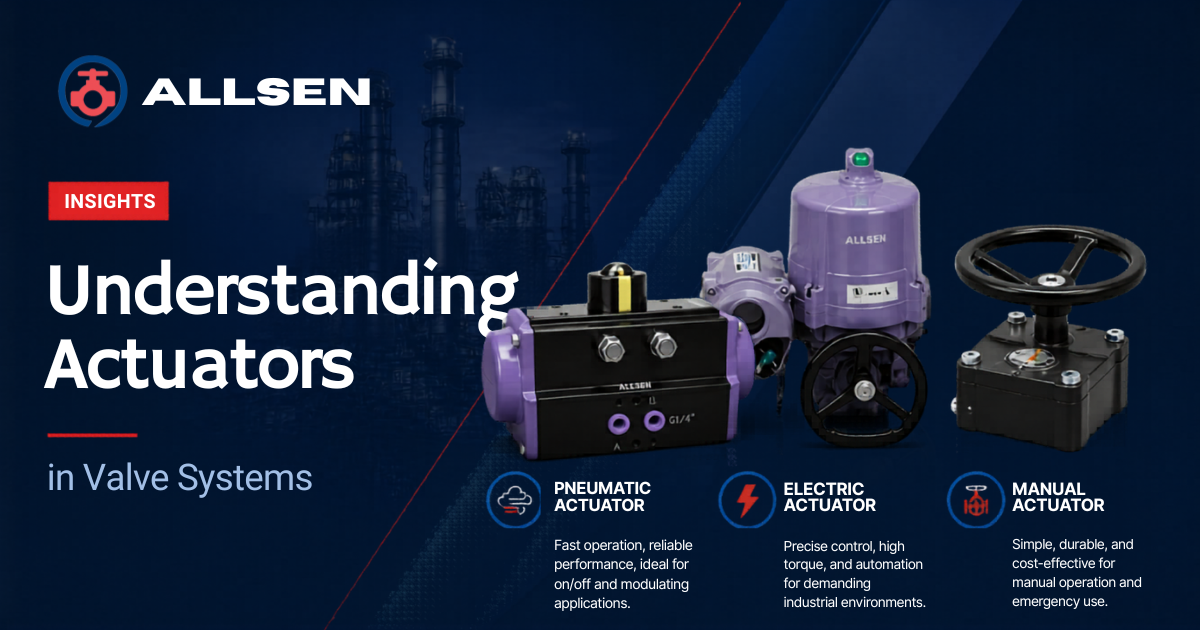
A clear, practical guide to manual, electric, and pneumatic actuators in valve system, covering automation benefits, safety requirements, and integration with modern industrial control systems.
A valve without an actuator is a manual device. A valve with the right actuator becomes part of an intelligent, responsive process system. Actuators are the interface between control logic and physical flow control. They determine how quickly a valve responds, how safely it behaves under abnormal conditions, and how effectively it integrates with the wider plant automation architecture.
For engineers specifying valve assemblies, actuator selection is as important as valve selection. The wrong actuator type or a correct type poorly configured creates reliability problems, safety gaps, and control system incompatibilities that are costly to correct in the field.
This article explains the three principal actuator types: manual, electric, and pneumatic. It then examines the benefits of valve automation, the safety considerations that govern actuator specification, and the practical requirements for integrating actuated valves into modern control systems. Whether you are designing a new plant or reviewing an existing system, this guide provides a technically grounded starting point.
Actuator Types
Each actuator type uses a different energy source to drive the valve. Therefore, the choice between manual, electric, and pneumatic operation depends on your power infrastructure, required response speed, control architecture, and environmental conditions.
 Manual
 Electric
 Pneumatic
Manual actuators: handwheels, levers, and gearboxes are the simplest and most cost-effective options. They require no external power source. However, they demand physical presence at the valve location and cannot be operated remotely. They are therefore best suited to infrequent isolation duties, small-bore valves in accessible locations, and as backup override devices on automated assemblies.
Electric actuators use a motor and gearbox to drive the valve stem. They offer precise positioning, feedback signals, and full compatibility with digital control systems. Modern multi-turn and part-turn electric actuators include integral position encoders, torque monitoring, and fieldbus communication interfaces. They are well suited to remote and automated applications. However, they require a reliable electrical supply and careful consideration in hazardous area classifications.
Pneumatic actuators use compressed instrument air to move a piston or diaphragm. They are fast, reliable, and inherently safe in flammable atmospheres, making them the dominant choice in oil, gas, and chemical plants. Spring-return designs provide a defined fail-safe position on loss of air supply. Consequently, pneumatic actuators remain the industry standard for safety-critical isolation and emergency shutdown applications.
Selection Note: Pneumatic actuators suit rapid on/off applications; electric actuators suit precise modulating control. Manual actuators serve as backup or in low-frequency, non-automated services. Combining all three is common in complex valve assemblies for example, a pneumatic actuator with a manual handwheel override and an electric positioner.
Automation Benefits
Valve automation delivers measurable improvements across plant safety, efficiency, and operational reliability. Therefore, it is increasingly the default specification for new process plant design and a common retrofit target in aging facilities.


Reduced human error. Automated valves respond to control signals, not operator judgement. This removes the risk of incorrect valve state during critical process transitions or emergency events.
Faster response times. Pneumatic actuators can open or close a valve in seconds. This speed is essential in emergency shutdown sequences, pressure surge events, and rapid process changes.
Remote operation. Actuated valves can be controlled from a central control room or remotely via SCADA. This is critical in hazardous locations, offshore platforms, and unmanned facilities.
Real-time position feedback. Electric and smart pneumatic actuators continuously report valve position to the control system. This enables operators to verify valve state without physical inspection.
Consistent cycle performance. Automated actuators execute valve cycles with repeatable precision. This consistency protects seats and trim from the uneven wear caused by manual operation.
Predictive maintenance data. Smart actuators log torque trends, cycle counts, and response times. This data supports condition-based maintenance programs and early fault detection.
Together, these advantages make actuated valve systems a central component of modern plant reliability strategy, reducing downtime, lowering maintenance costs, and improving overall process yield.
Safety Considerations
Safety is not an optional feature in actuated valve design, it is a fundamental engineering requirement. In process plants, the consequences of an actuator failing in the wrong position can be severe. Therefore, safety considerations must be addressed at every stage of actuator specification and installation.
The most important safety question in actuator specification is: what should the valve do if it loses its energy supply? A fail-closed actuator drives the valve shut on loss of air or power, isolating flow to prevent release of hazardous material. A fail-open actuator drives the valve open, maintaining flow to prevent overheating or pressure build-up in cooling or relief systems. The correct choice depends entirely on the process safety requirements for each specific valve function, as defined in the Process Hazard Analysis (PHA) and Safety Requirements Specification (SRS).
 Fail-Closed Applications
Fuel gas feed valves, chemical injection systems, toxic fluid isolation, emergency block valves, and fire-safe isolation duties.
 Fail-Open Applications
Cooling water supply valves, reactor temperature control, pressure relief bypass, and systems where flow interruption creates greater risk than release.
 SIL Compliance
Safety Instrumented System (SIS) valves must be specified and proof-tested to the Safety Integrity Level defined in IEC 61511 for their Safety Instrumented Function.
 Fire-Safe Certification
Actuated valves in hydrocarbon service should carry fire-safe certification to API 607 or BS EN ISO 10497, ensuring sealing integrity survives exposure to fire conditions.
Electric actuators in areas where flammable gases or vapors may be present must be certified to the appropriate hazardous area classification – ATEX in Europe, IECEx internationally, or NEC Article 500/505 in North America. Pneumatic actuators, by contrast, are inherently spark-free and therefore simpler to deploy in classified zones. However, their associated solenoid valves and limit switches still require area-appropriate certification.
Control Integration
A standalone actuated valve delivers automation at the device level. However, the full value of valve automation is realized when actuators integrate with the plant’s control architecture enabling coordinated process management, real-time diagnostics, and data-driven maintenance. This integration is now a standard expectation in modern plant design.
| Control System | Actuator Interface | Typical Application |
|---|---|---|
| DCS (Distributed Control System) | 4–20 mA, HART, Fieldbus | Process control loops, modulating valves |
| PLC (Programmable Logic Controller) | Digital I/O, Profibus, Profinet | Sequential control, on/off duties |
| SIS (Safety Instrumented System) | Dedicated SIL-rated I/O loops | ESD, SIF-rated isolation valves |
| SCADA | Modbus, OPC-UA, Ethernet/IP | Remote monitoring, pipeline control |
| Asset Management Systems | HART, FDT/DTM, WirelessHART | Diagnostics, predictive maintenance |
Smart valve positioners fitted to pneumatic control valves translate a 4–20 mA or digital fieldbus signal into precise valve position. They continuously compare commanded and actual position, adjusting pneumatic output to eliminate error. Modern positioners communicate via HART, Foundation Fieldbus, or PROFIBUS PA protocols, transmitting valve diagnostics including signature curves, friction analysis, and seat leakage indicators directly to the asset management system.
This integration enables partial stroke testing (PST) of emergency shutdown valves without full process interruption. PST exercises the valve through a defined partial travel while online, verifying actuator and positioner functionality against the proof test requirements of IEC 61511. Therefore, it significantly extends the intervals between full offline proof tests reducing plant disruption while maintaining safety system integrity.
Integration Tip: Specify actuators with built-in HART or fieldbus communication from the outset, even for simple on/off duties. The marginal cost at specification stage is far lower than retrofitting communication capability in the field. The diagnostic data available through these interfaces consistently pays for itself in reduced unplanned maintenance.
Actuators are far more than mechanical accessories bolted to a valve. They determine how a valve behaves under normal and abnormal conditions, how it communicates with the control system, and how safely it responds when something goes wrong.
Selecting the right actuator type manual, electric, or pneumatic requires a clear understanding of the application duty, safety requirements, control architecture, and environmental conditions. However, the broader principle is consistent across all applications: the actuator and the valve must be specified together, as a single functional unit, against the same process and safety criteria.
As industrial plants move toward greater automation, digital integration, and data-driven maintenance, the actuator becomes the primary point of connection between physical flow control and the plant’s intelligence infrastructure. Getting this specification right is one of the most impactful engineering decisions in any process plant design.
Our engineering team works with plant designers and procurement teams to specify actuated valve assemblies that meet process, safety, and control system requirements. If you are reviewing an existing system or designing a new one, we are happy to assist — with no obligation.